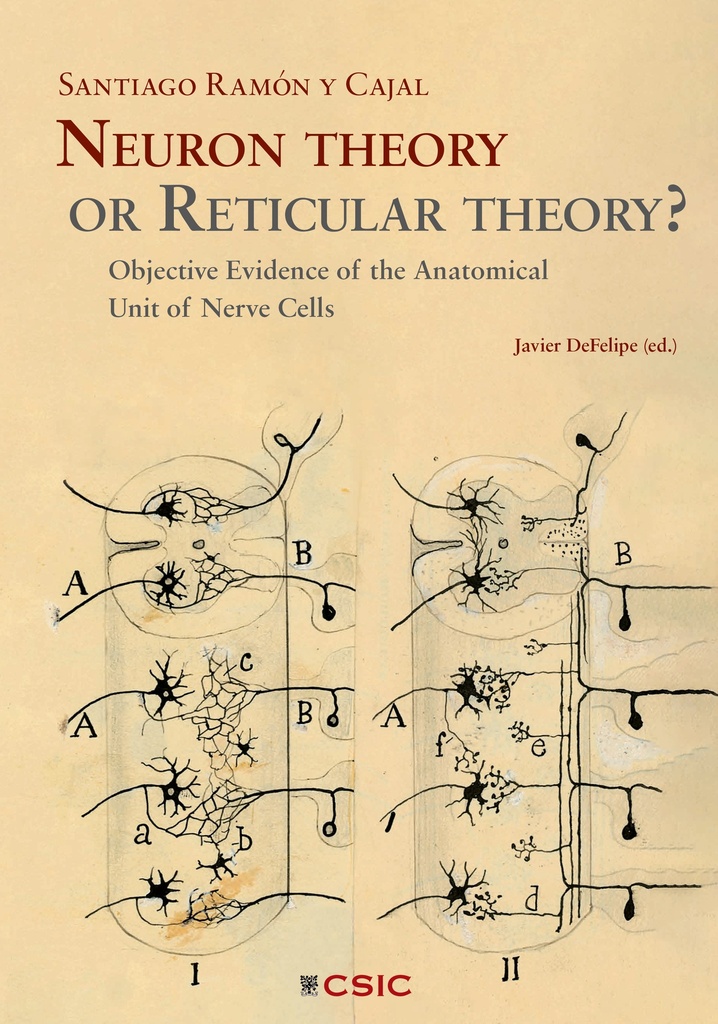
Current knowledge of the nervous system, particularly the brain, is the result of technological advances and the collective effort of many scientists. However, it was Santiago Ramón y Cajal (1852–1934) who played a crucial role in the emergence of modern neuroscience. His extraordinary ability to observe and interpret microscopic images allowed him to discover details overlooked by others, thus revolutionizing the understanding of the nervous system. Cajal investigated the microanatomy of almost the entire nervous system and formulated theories about its function, development, and plasticity, which profoundly influenced the science of his time and laid the foundations for current neuroscience. Among his greatest achievements was his defense of the neuron theory, which establishes that neurons are individual units, as opposed to the reticular theory that proposed a continuous network. His seminal work on this debate, “¿Neuronismo o Reticularismo?”, was published in 1933 in the journal Archivos de Neurobiología. The text in this reissue remains faithful to the original, preserving its explanatory notes and bibliographic citations intact. Linguistically, the text remains perfectly understandable, although some outdated scientific terms have been reviewed and replaced with their current equivalents. This edition also includes an introductory chapter expanding on the historical aspects of the debate, a section on the ultrastructural confirmation of the neuron theory through electron microscopy, and an analysis of recent findings that challenge some aspects of this theory. With 73 figures, including 42 original drawings by Cajal, this reissue serves as a valuable reference for the scientific community and a tribute to the legacy of one of the greatest pioneers of neuroscience.